

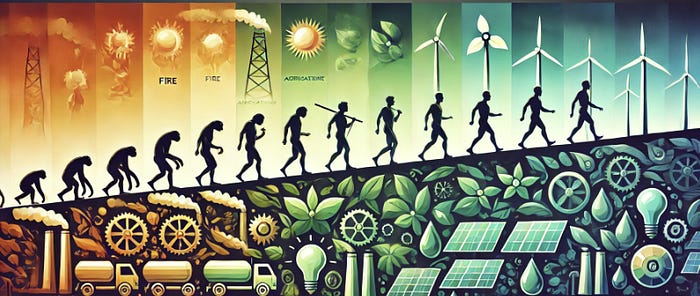
Energy has always been the foundation of civilization. From fire to fossil fuels to electricity, each major leap in energy systems has unlocked new phases of human progress.
But today, energy is no longer just enabling growth, it is becoming the primary constraint on it.
We are entering a moment where three powerful forces are converging:
Geopolitical instability, including rising tensions in the Middle East and potential disruptions to global energy supply
The rapid acceleration of artificial intelligence, driving unprecedented demand for electricity
Aging infrastructure that was never designed for this level of scale, speed, or complexity
In prior eras, energy innovation was about efficiency and cost. Today, it is about capacity, resilience, and control.
The rise of AI and hyperscale data centers has transformed energy from a background utility into a strategic asset. Compute is no longer limited by chips alone. It is constrained by power, cooling, and grid access.
This shift marks the beginning of a new phase in the evolution of energy systems, one where energy and intelligence are deeply intertwined. We are not running out of compute. We are running into the limits of energy.
The Historical Significance of Energy
In early civilizations, humans primarily focused on survival, constantly struggling to find a stable food supply. The advent of agriculture transformed this dynamic, allowing populations to grow from small, nomadic groups to vast, settled communities. For example, the global population increased from about 5 million in 10,000 BCE to over 250 million by the first century CE, largely due to increased food production from agricultural advancements. During this period, humans relied on animals for labor, using their strength to plow fields and transport goods. Energy consumption was limited by the availability of food for both humans and animals, making food the primary energy source.
The Industrial Revolution marked a pivotal transformation, expanding human energy use beyond biological sources to include fossil fuels such as coal and oil. This era introduced groundbreaking technologies like steam engines and automobiles, revolutionizing transportation and manufacturing. These advancements catalyzed a period of remarkable growth and innovation, fundamentally changing economic structures and daily life, and setting the stage for the modern industrialized world. This shift not only increased the scale of human activity but also began the complex relationship between energy consumption and environmental impact, framing many of the challenges and opportunities we face today.
The Modern Energy Landscape
The modern energy landscape is being reshaped by a surge in demand driven by population growth, electrification, and rapid technological advancement. From electric vehicles to cloud computing and artificial intelligence, new systems are increasingly energy-intensive. Despite significant expansion in clean energy, supply is struggling to keep pace with this accelerating demand, leading to visible strain on power systems globally.
By 2030, data centers in the United States are projected to consume approximately 8% to 10% of total electricity demand, up from roughly 3% in 2022. This sharp increase is driven primarily by artificial intelligence and other compute-intensive workloads. AI is emerging as the dominant source of incremental demand, with data centers supporting these workloads expected to more than double their electricity consumption over the coming decade due to the higher energy density required for training and inference at scale.
Historical infrastructure cycles highlight the magnitude of this shift. Early internet infrastructure operated at relatively modest scale, requiring only a few gigawatts of power. The rise of cloud computing expanded this to tens of gigawatts over more than a decade. Today, we are entering a new phase defined by AI, sometimes referred to as Cloud 2.0 or Internet 3.0, where demand is accelerating much faster. Instead of multi-decade buildouts, infrastructure is scaling within just a few years, with projected demand reaching tens to potentially hundreds of gigawatts globally.

Balancing the Trade-offs in Energy Production
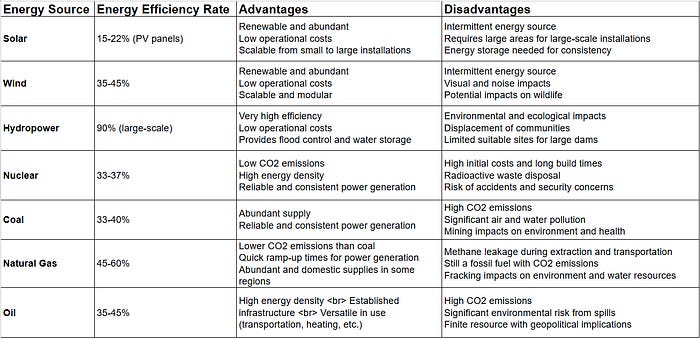
Despite significant investments in renewable energy sources such as hydro, solar, and wind, these technologies have not yet supplanted traditional fossil fuels as the dominant energy sources. As of 2024, the global energy mix remains predominantly reliant on fossil fuels. Coal, oil, and natural gas together account for approximately 79% to 80% of total primary energy consumption, spanning electricity, heating, transportation, and industrial use. Despite rapid growth in renewable energy, this share has only declined modestly over the past three decades, highlighting the structural inertia of global energy systems.
The real-time operation of the electricity power grid presents a challenge for aligning clean energy production with daily consumption patterns. Solar energy is only available during the day, wind energy typically increases at night, and hydroelectric power fluctuates seasonally, leading to limitations and unreliability in their production timing. Energy storage systems, such as batteries, play a crucial role in addressing this mismatch by storing excess energy during low-demand periods and releasing it during peak times. However, utility-scale batteries typically have a round-trip efficiency of about 80%, meaning that 20% of the stored energy can be lost in the process of charging and discharging.
To ensure sustained energy growth while fostering a sustainable environment for future generations, it is crucial to balance and continually enhance our mix of energy sources by leveraging technology to optimize energy sources and consumption.
The Convergence of Energy and Intelligence
As energy systems face increasing strain, a new layer of innovation is emerging at the intersection of energy and computation. Artificial intelligence is not only driving demand for energy. It is also becoming a critical tool for managing it.
Energy-Integrated Infrastructure
Data centers are beginning to co-locate directly with power generation. Instead of relying solely on the grid, they are being built alongside:
Renewable energy farms paired with storage
Hydroelectric facilities
Next-generation nuclear systems
This reduces transmission bottlenecks and improves reliability at scale.
Intelligent Grids and Software-Defined Energy
The integration of software into energy systems is accelerating.
AI-driven platforms can optimize energy flows in real time, improving efficiency across generation, transmission, and consumption. This transforms the grid from a rigid system into a programmable one, where intelligence plays a central role in maintaining stability.
Energy-Aware Compute and Model Efficiency
As energy becomes a constraint, efficiency becomes a competitive advantage.
We are seeing increased focus on:
More efficient model architectures
Hardware optimization for lower energy consumption
Workload scheduling based on energy pricing and availability
The next generation of AI systems will not just be more powerful. They will be more energy efficient by design.
New Bottlenecks, New Opportunities
As the system evolves, value is shifting to previously overlooked components:
Cooling technologies, including liquid and immersion cooling
Power electronics and transformers
Long-duration energy storage solutions
These are no longer peripheral technologies. They are becoming essential to scaling both energy and compute infrastructure.
Energy: The Foundation of the Visionary Economy
Energy has always shaped the trajectory of human progress. But in this new era, its role is expanding once again.
We are moving from a world where energy powers industry to one where it powers intelligence.
At the same time, geopolitical uncertainty, infrastructure constraints, and accelerating demand are redefining the limits of growth. The challenge is no longer simply generating more energy. It is orchestrating a system that can deliver it reliably, efficiently, and at the scale required by modern computation.
In the Visionary Economy, energy is no longer a background input. It is a foundational layer of innovation.
The most valuable systems of the future will not be defined solely by better algorithms or faster chips. They will be defined by the integration of:
Compute
Energy
Infrastructure
Intelligence
The winners will be those who understand this convergence and build systems that align multiple layers seamlessly. Because in the age of AI, energy is no longer just part of the economy. It is a core component that defines what is possible.