

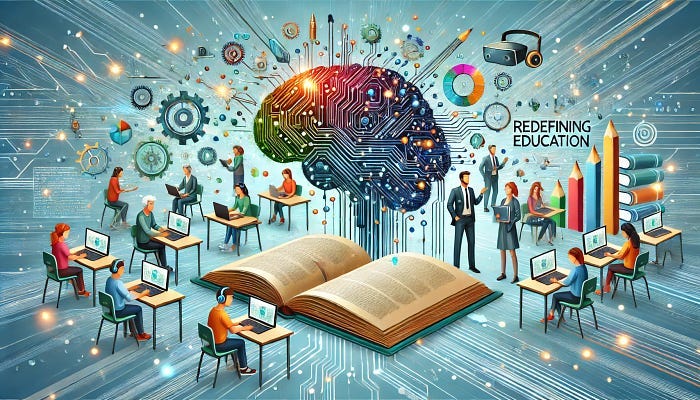
What if the education system we’ve trusted for centuries is no longer sufficient for the future we’re entering? Imagine an education model designed like a factory, primarily focused on churning out workers trained to perform specific tasks within a narrow set of roles. This system, founded on a one-size-fits-all approach, including standardized tests and predetermined career paths, has been the backbone of our society. But now, as AI and automation become ever more integral to our economic fabric, we find this model drastically inadequate. Now, we are on the brink of a fundamental shift, we need to reevaluate both the purpose and methods of education in an economy driven by innovation knows no bounds.
The Rapid Shift in Career Paradigms
Our educational methodologies have become stagnant, entrenched in a cycle of standardized learning and mere replication of existing knowledge. Students are shaped to fit a pre-existing mold, reduced to cogs in an industrial machine, crafted to function as repetitive production engines in society.
In the traditional career model, we envision a linear path: graduate from university by around age 22 and embark on a roughly 40-year career, climbing a vertical ladder from junior to senior positions within the same field. This approach made sense in an era where societal advancements were gradual, and careers were designed around mastering and performing a specific job function over a lifetime. However, in today’s world, where technological advancements occur at warp speed, this static career model and implementer mind set are increasingly obsolete.
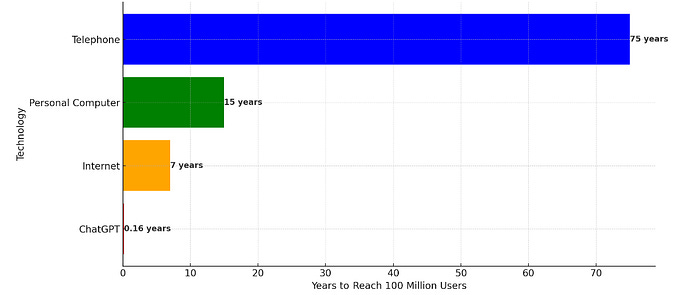
The speed of technological adoption has surged dramatically over the past two centuries, profoundly altering our daily lives and the very fabric of society. Imagine the early telephone, a groundbreaking invention of the 19th century, took a staggering 75 years to connect 100 million users. Fast forward to the late 20th century, when the personal computer (PC) burst onto the scene, revolutionizing how we gather, process, and share information. This digital marvel reached 100 million users in just 15 years. As we stepped into the 1990s, the internet began weaving its way into the public sphere, swiftly becoming a cornerstone of global communication, knowledge sharing, and commerce. Astonishingly, it crossed the 100 million user mark within about 7 years. Today, the pace of adoption has reached breakneck speeds with artificial intelligence leading the charge. ChatGPT, a cutting-edge AI, shattered previous records by amassing 100 million users in a mere 2 months.
Traditional job roles, once seen as lifelong vocations, are now fleeting. The idea of a “job for life” is becoming a relic of the past. As technology leaps forward, it outpaces the slow-changing social structures that once supported stable, long-term employment. Today, we are entering an era where flexibility and adaptability are paramount.
Careers now require individuals to pivot and evolve continuously, acquiring new skills and adapting to varied roles and industries. This shift is moving us away from being mere implementers of tasks to becoming lifelong learners and versatile contributors in a rapidly changing world. The reality is stark: adapt quickly or risk obsolescence. As we navigate this dynamic employment landscape, the challenge and opportunity lies in our ability to keep pace with the relentless speed of change, ensuring we remain relevant and resilient in the face of constant technological innovation.
Redefining in the AI Era
In the dance of progress, where do humans and AI partner to perform their best? Unlike machines, which excel in storing vast amounts of data and executing repetitive tasks flawlessly, humans bring to the table an “abstraction” ability that enables us to synthesize diverse information and solve problems creatively. Henry Ford, a pioneer of modern industry, once famously said that he didn’t need to know everything himself; with a simple press of a button, he could summon an expert to provide answers to any of his questions. Today, AI steps into those shoes, serving as our modern-day ‘button-pressed’ experts, thus freeing us to focus on innovation and strategic thinking.
In this rapidly evolving landscape, our educational system needs transformations. It shouldn’t aim to churn out more efficient human implementers. Instead, it should nurture learners’ ability to think creatively and use knowledge innovatively. Our children need to be taught not just to answer questions, but to question the answers, and equally importantly, to master the art of asking the right questions. After all, framing the right question is often half the battle won.
Traditional educational assessments too often prioritize memorization, undermining the real essence of learning: comprehension and application. In the era of AI, where factual knowledge is at everyone’s fingertips, the true value lies in making connections, thinking outside the box, and navigating complex challenges. This shift from mere information regurgitation to fostering deep understanding and innovative application is crucial. By redefining our approach to learning in this way, we prepare ourselves not just to coexist with AI but to collaborate effectively, ensuring that both humans and artificial intelligence can thrive synergistically in a future crafted by both.
As we reconsider what we value in education, it’s clear that the focus should shift from preparing students for specific jobs to equipping them with the skills necessary to thrive in an AI-enhanced world. This includes fostering design thinking, creative problem-solving, and an entrepreneurial mindset. Moreover, the integration of AI into education can provide personalized learning paths that adapt to individual needs, further enhancing engagement and effectiveness.
The essence of humanity lies in our innate capacity to evolve — to become, rather than merely to be. We are more than just “human beings”; we are “human becomings,” perpetually striving to improve and transform into better versions of ourselves.
Investing in Human Capital: An AI-Era Education Strategy
From a venture perspective, education is not about curriculum reform. It is about capital allocation. The question is simple: what kind of human capital will compound in an AI-driven economy?
1. Design Thinking Over Task Training
As AI absorbs routine execution, the highest-return skill shifts to problem framing, systems thinking, and creative synthesis. Education should train students to identify opportunities, not just complete assignments. In venture terms, we are investing in founders of ideas, not operators of instructions.
2. AI as Leverage, Not a Shortcut
Personalized learning powered by AI is not about convenience. It is about increasing cognitive ROI. When students can iterate faster, simulate scenarios, and explore ideas dynamically, learning becomes compounding rather than linear. AI becomes a force multiplier for curiosity.
3. 0→1 Capability
In venture capital, outsized returns come from nonlinear breakthroughs. Education should cultivate the ability to build from zero to one, not just optimize from one to ten. That means encouraging experimentation, tolerating failure, and rewarding original thinking over standardized correctness.
4. Lifelong Learning as Career Infrastructure
Careers are no longer vertical ladders. They are dynamic portfolios of skills. Education should become a continuous platform rather than a one-time phase. The most valuable individuals will not be those with static expertise, but those who can repeatedly re-skill and reposition themselves as markets evolve.
5. Global and Cross-Disciplinary Fluency
The most successful companies operate across borders and industries. Human capital should do the same. Cultural agility, interdisciplinary thinking, and collaborative intelligence will define leadership in a distributed, AI-enabled world.
As AI reshapes the economic landscape, education cannot remain static. It needs to evolve from training for tasks to cultivating judgment, creativity, and resilience. The goal is not to prepare students to compete with machines, but to guide them. In the Visionary Economy, the future belongs to those who can think deeply, adapt continuously, and choose wisely in a world of accelerating possibility.
"not just to answer questions, but to question the answers, and equally importantly, to master the art of asking the right questions."
This is so true, on many AI tools, output depends on quality of prompts. Knowing what to ask, how to understand and communicate our core intent to machines, becomes an essential skill