

In Part 1, I argued that the old model of cheap labor manufacturing is breaking.
But the answer is not simply to bring the old factory home.
The real opportunity is to build a new kind of factory: one that operates more like an AI system than a traditional assembly line.
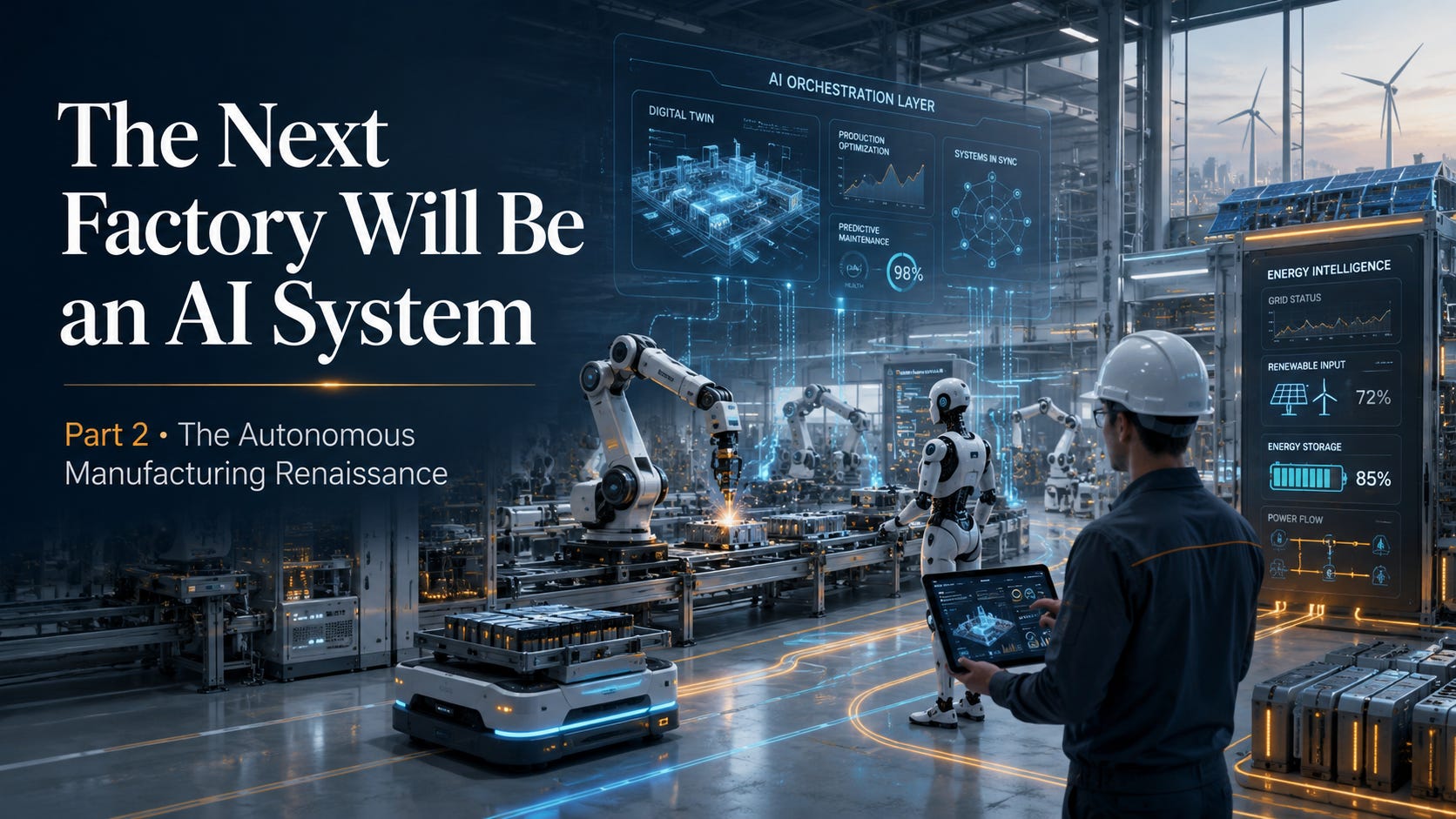
The factory of the future will not just have more robots. It will have sensors, computer vision, digital twins, AI agents, predictive maintenance, autonomous workflows, and real-time data loops. Feedback loop is important.
Machines will not just produce goods.
They will generate data.
That data will improve quality, reduce downtime, optimize production, and teach the factory how to become more efficient over time.
This is the rise of the autonomous factory.
From Automation to Autonomy
Automation is not new.
Industrial robots have been used for decades in automotive, electronics, and heavy manufacturing. They are powerful, precise, and tireless.
But traditional robots were mostly narrow. They performed predefined tasks in structured environments. They could weld the same part, lift the same object, paint the same surface, or assemble the same component.
They were excellent at repetition. They were weak at adaptation.
AI changes that.
With computer vision, better sensors, simulation, reinforcement learning, and large AI models, robots are becoming more flexible. They can recognize variation. They can adjust to changing environments. They can learn from demonstration. They can move closer to general-purpose industrial work.
The Factory Becomes a Learning System
The most important shift is not that robots enter the factory.
It is that the factory itself becomes intelligent.
In the old model, a factory was mostly a physical asset. Machines, workers, inventory, production lines, loading docks, and warehouses.
In the new model, the physical factory is surrounded by a digital intelligence layer.
Sensors monitor machines in real time. Computer vision systems inspect products. Digital twins simulate production changes before they are made. AI agents schedule workflows. Predictive maintenance systems detect equipment problems before they cause downtime.
Every defect, every delay, every process improvement becomes signals.
The factory learns. That is a profound shift.
A traditional factory depreciates over time: Machines age. Processes become outdated. Workers leave and take experience with them.
An AI-native factory can improve over time. Its physical assets may still age, but its operating intelligence can compound.
The most valuable layer may not be the robot itself. It may be the intelligence layer that coordinates the entire production environment.
Energy Becomes the New Labor Input
The autonomous factory also changes the role of energy.
In the old manufacturing economy, the key question was often labor availability.
Can we hire enough workers?
Can we train them?
Can we manage turnover?
In the autonomous manufacturing economy, another question becomes just as important: Can we power the factory reliably and affordably?
Robots, AI systems, sensors, data infrastructure, climate control, advanced machinery, and digital manufacturing systems all depend on electricity.
A robot does not need lunch, sleep, or a commute.
It needs power, uptime, maintenance, software and data.
That means energy becomes a core manufacturing input.
Countries and regions with cheap, reliable, and scalable energy will have an advantage. Those with expensive or unstable energy will face pressure.
This is why manufacturing strategy, AI strategy, and energy strategy are converging.
The future industrial map may be shaped not only by where labor is cheapest, but by where electricity is abundant, reliable, and politically secure.
Manufacturing Gets Faster, Closer, and More Customized
The old offshore model rewarded massive scale.
Large factories produced huge quantities of standardized products for global distribution. This was efficient, but not very flexible.
AI-native factories support a different model.
Smaller production runs.
Faster reconfiguration.
More localized products.
Shorter lead times.
Less inventory risk.
Closer connection to customer demand.
This matters because markets now are fragmenting. Consumers want more personalization. Product cycles are shortening. Companies need to respond faster to local tastes, regulatory requirements, and demand changes.
A robotic factory near the customer does not need to beat Asia on wage cost alone.
It can win on speed, flexibility, quality, resilience, and total landed cost.
That will not apply to every product. Many commodity goods will still be produced in large centralized facilities.
But for high-value, customized, regulated, urgent, or strategically sensitive products, proximity becomes powerful.
Manufacturing may shift from a small number of massive global production hubs to a network of intelligent production nodes.
The Human Role Changes
The autonomous factory does not make humans irrelevant.
It changes what humans do.
The old factory relied heavily on repetitive human labor. Many roles were physically demanding, repetitive, and sometimes dangerous.
The new factory needs more technicians, robot supervisors, systems operators, data analysts, maintenance specialists, process engineers, safety experts, and workflow designers.
In the Visionary Economy, the human role shifts from doing repetitive tasks to managing, improving, and collaborating with intelligent machines.
The highest-value human contribution will not be repetitive motion. It will be judgment, creativity, technical skill, and the ability to work with intelligent systems.
The Autonomous Manufacturing Renaissance
The next manufacturing advantage will not come from a race to the bottom on wages, and for advanced economies, it should not.
It should come from combining robotics, AI, energy, software, and human creativity into a new industrial stack.
This is why the manufacturing renaissance is not just about reshoring.
It is about rebuilding industrial capacity for a different world.
A world where
resilience matters.
energy matters.
speed matters.
trust matters.
intelligence matters.
The old manufacturing economy asked people to fit into the rhythm of machines. The new manufacturing economy will ask machines to amplify the creativity of people.
That is the deeper promise of the autonomous manufacturing renaissance.
Not cheaper production or robots on factory floors.
Not just bringing manufacturing back.
Building the next intelligence factory.