

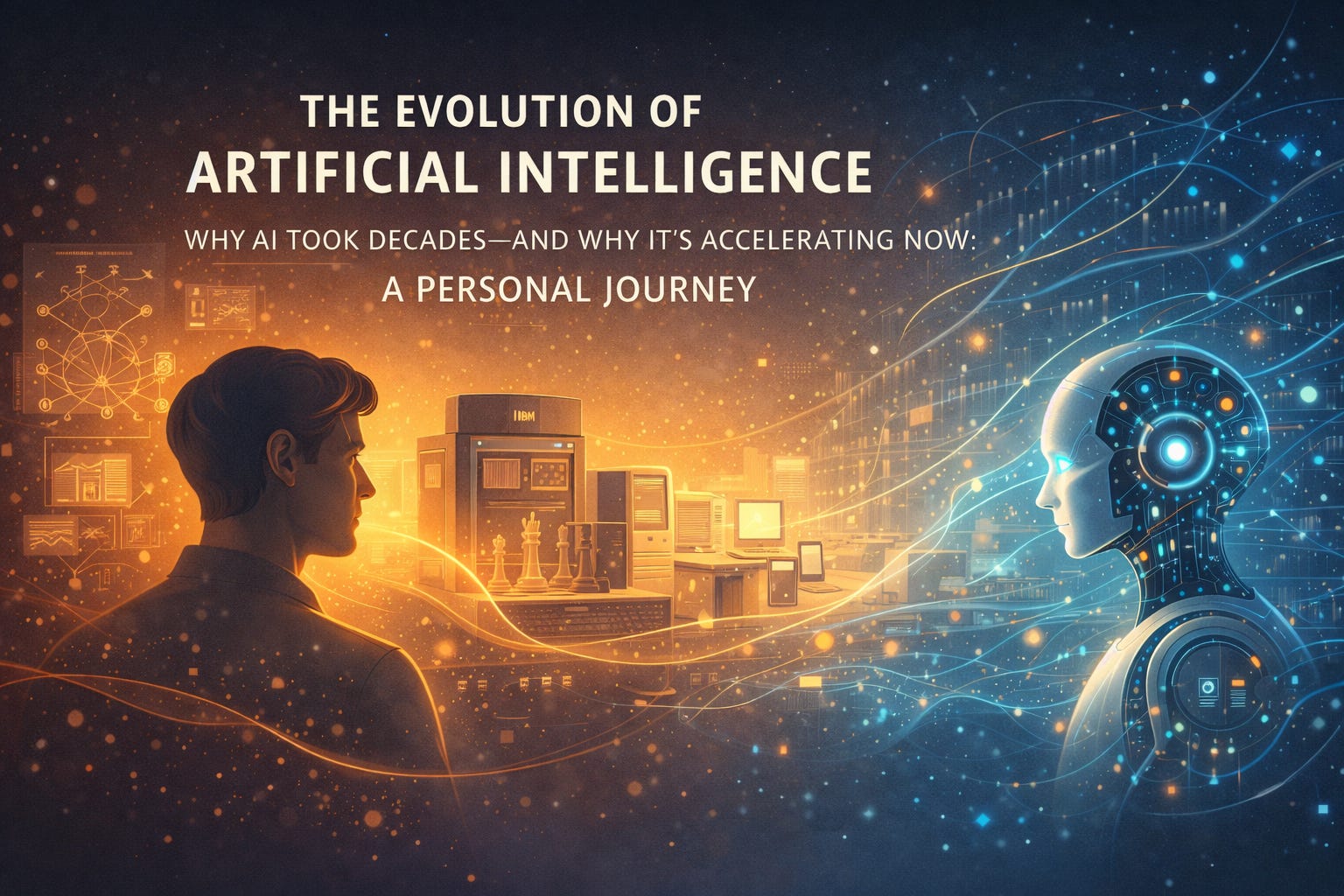
The rise of artificial intelligence did not happen overnight. Nor was it triggered by a single breakthrough or sudden insight. Many of the ideas behind modern AI are decades old. Neural networks, the conceptual backbone of today’s deep learning systems, were first proposed in the mid twentieth century and actively researched throughout the 1980s and 1990s.
The idea was right.
The timing was wrong.
For most of its history, AI existed in the gap between theoretical promise and practical limitation. Researchers understood how machines might learn, but the world lacked the conditions required to make those ideas work at scale. Artificial intelligence was not waiting for intelligence. It was waiting for infrastructure.
Phase I: The Idea Without the Means
Early neural networks were inspired by biology. They attempted to replicate learning through layered connections, weighted signals, and iterative adjustment. By the late 1990s, the mathematics of learning were largely understood. Backpropagation worked. Small models could be trained. In controlled environments, limited success was possible.
But progress stalled.
This era produced one of the most famous milestones in AI history: IBM Deep Blue defeating Garry Kasparov, the reigning world chess champion, in 1997. It was a defining moment, not because the machine “thought,” but because it demonstrated how far computation could go when pushed to its limits.
Deep Blue did not learn.
It calculated.
The system relied on brute-force search, evaluating up to 200 million chess positions per second, guided by human-crafted heuristics and domain expertise. I was there in IBM Watson Research as an architect and developer, building a middleware that allowed the system to scale reliably under extreme computational load. The Deep Blue achievement was extraordinary, but it revealed an important truth: this was not intelligence emerging. It was human optimization amplified by hardware.
Deep Blue showed what machines could do when rules were explicit and the problem space was closed. It did not generalize or adapt. It was intelligence by exhaustion, not by understanding.
The broader field of AI faced the same limits.
Three constraints held progress back.
Compute was insufficient. Training neural networks on CPUs was slow, expensive, and impractical beyond small experiments. Scale was impossible.
Data was limited. The world had not yet digitized itself. Language, images, behavior, and interaction were largely offline, leaving researchers with small, artificial datasets disconnected from real human complexity.
Distribution was weak. Even when systems worked in laboratories, there was no scalable way to deploy them, learn from usage, or iterate in real environments.
AI entered multiple “winters” not because the ideas were wrong, but because the world itself was not yet ready.
The vision of learning machines existed.
The infrastructure did not.
What Deep Blue represented was the ceiling of the old paradigm: intelligence achieved through exhaustive calculation and human-designed rules. What came next would require something fundamentally different, not more clever algorithms, but a world large enough, fast enough, and connected enough for machines to learn from reality itself.
Phase II: The World Digitizes
The first major unlock was not an AI breakthrough. It was the internet, followed by its expansion into mobile life and cloud infrastructure.
I watched this transformation firsthand. At Cisco, during the formation years of the modern internet, we were not thinking about artificial intelligence. We were thinking about connectivity, scale, and reliability. Routers, switches, protocols, middleware. The goal was simple: move information faster, farther, and more reliably. What we did not fully realize at the time was that we were laying the foundation for something far larger than communication.
The internet quietly turned human behavior into data.
Emails replaced letters. Search engines indexed human curiosity. Social platforms captured language, emotion, and interaction at global scale. Smartphones extended the network into every pocket, turning daily life into continuous streams of text, images, voice, location, and behavior. Cloud infrastructure centralized storage and computation, making that data accessible, persistent, and programmable.
From inside the system, it felt like infrastructure work. From a distance, it was something else entirely.
By the late 2000s, humanity had unintentionally created what artificial intelligence had always needed: a vast, living record of how humans see, speak, decide, and interact with the world. Not synthetic datasets. Not laboratory examples. Real behavior, at planetary scale.
Still, data alone was not enough.
Phase III: When Scale Proved the Theory
The turning point came when data and compute finally converged.
GPUs, originally designed for rendering images and video games, turned out to be perfectly suited for the parallel mathematical operations required to train neural networks. What had once been slow and impractical suddenly became feasible. Training times collapsed. Model sizes expanded. Experiments that once took weeks could now be repeated in days or even hours.
This new computational power needed a proving ground. ImageNet became that moment.
ImageNet was more than a dataset. It was a test of scale. With millions of labeled images spanning thousands of categories, it created an environment large enough to expose what neural networks were capable of when freed from data and compute constraints. When deep learning models were trained on ImageNet using modern GPUs, performance did not inch forward. It leapt. The results were not incremental improvements but unmistakable breakthroughs that signaled a permanent shift in how intelligence would be built.
Decades of handcrafted features were rendered obsolete almost overnight. Systems that learned directly from data decisively outperformed those built on human assumptions.
The debate ended.
The lesson was unmistakable. Intelligence does not emerge from clever rules written by humans. It emerges from learning at scale.
Neural networks had always been capable of abstraction. They simply needed enough data, enough compute, and a world large enough to learn from.
Phase IV: Teaching Machines to Decide
If ImageNet taught machines how to see, reinforcement learning taught them how to choose.
Reinforcement learning is not about correct answers. It is about experience. An agent acts, observes outcomes, and adjusts behavior through feedback. For decades, this approach remained mostly theoretical. Real environments were too complex. Training was unstable. Exploration was costly.
Scale changed that.
When reinforcement learning merged with deep neural networks and large scale simulation, machines began learning strategies rather than scripts. They planned across time. They adapted to uncertainty. They discovered solutions no human explicitly programmed.
This marked a second leap. AI systems were no longer limited to perception. They could now learn action, consequence, and adaptation.
Machines began to operate in environments rather than simply classify them.
Phase V: Generalization at Last
With data, compute, perception, and decision-making finally aligned, a final shift occurred.
Researchers stopped building systems designed for single tasks and began training models designed to absorb the world itself. These foundation models were not programmed with rules or logic. They were trained as vast probabilistic engines, exposed to enormous swaths of human language, images, code, and behavior, and asked to predict what comes next.
Language models did not memorize grammar. They inferred it. They did not store facts explicitly. They absorbed patterns of meaning, causality, and context distributed across billions of examples. Multimodal models extended this process across text, images, audio, and action, learning how different forms of information align and reinforce one another.
The breakthrough was about generalization of accessing knowledge
A single model could now adapt across tasks without being rebuilt or retrained from scratch. Writing, reasoning, translation, analysis, design, and simulation all flowed from the same underlying system. Intelligence became reusable rather than bespoke. Learning became cumulative rather than isolated.
This was the moment artificial intelligence stopped being fragile.
AI is the apex of technology evolution
Artificial intelligence did not emerge from a single breakthrough. It emerged when long-delayed conditions finally aligned.
The core ideas had existed for decades.
The data arrived as the world digitized itself.
The compute arrived through GPUs and distributed systems.
Scale was proven through ImageNet.
Adaptation came with reinforcement learning.
Generalization followed with foundation models.
Individually, none of these advances was sufficient. Together, they made rapid progress unavoidable.
What appears sudden is the result of accumulation. Years of theory, infrastructure, and experimentation quietly prepared the ground. Once learning could scale across data, compute, and experience, intelligence could scale as well.
Acceleration was not a surprise. It was the natural outcome of maturity.