

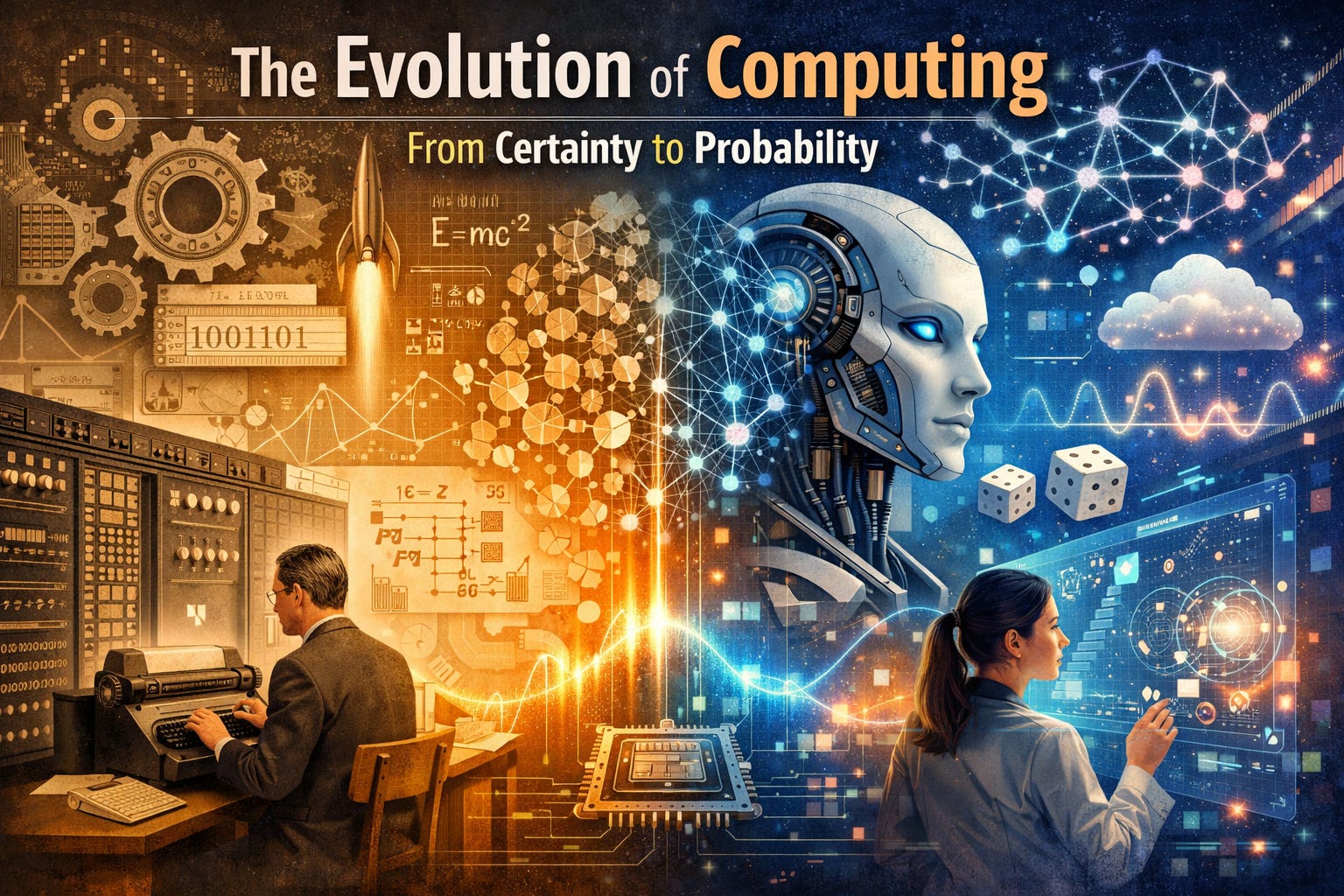
Artificial intelligence did not only arrive as a new technology. It arrived as a new way of computing.
For most of modern history, computation was built on certainty. Early computers were deterministic machines. Given a specific input, they produced a single, predictable output every time. This model aligned perfectly with engineering, accounting, and science, domains where precision and repeatability were essential. Computing was about rules, logic, and control.
That paradigm shaped how we understood machines for decades.
Deterministic Computing: The Era of Certainty
Think about a simple calculator: when you input 2 + 2, the result is always 4. There is no ambiguity, no interpretation, no context. The system follows a fixed set of instructions, and the result is guaranteed.
This is deterministic computing. It excels when problems are well defined, environments are stable, and correctness can be mathematically proven. From spreadsheets to flight control systems, deterministic machines became the backbone of the modern world because they were reliable, consistent, and exact.
But this strength also revealed a limitation.
Deterministic systems struggle because the world is not precise.
When Certainty Breaks Down
Human reality is not binary. We make decisions with incomplete information, shifting context, and competing signals. We reason in probabilities. We revise beliefs. We act without guarantees.
As computing moved beyond arithmetic into perception, language, and decision making, the limits of deterministic logic became impossible to ignore. Many of the problems that matter most cannot be reduced to fixed rules or exact answers. Traditional computing could assist humans, but it could not reason alongside them.
This is where artificial intelligence changed the nature of computing itself.
Indeterministic Computing: A New Paradigm
Indeterministic computing does not aim for certainty. It operates on probability.
Instead of producing one guaranteed answer, these systems generate likelihoods. They infer patterns from data and respond based on what is most plausible. The same input may produce different outputs depending on context, training, or randomness.
This is not a flaw. It is a new way of computing.
Modern AI systems assess the world the way humans do, by weighing evidence, navigating ambiguity, and adapting as new information appears. Language models, for example, do not retrieve answers from a rulebook. They predict responses based on learned statistical structure. Vision systems recognize objects not by definition, but by probability.
For the first time, computing began to resemble human reasoning.
Error, Uncertainty, and Human Likeness
This probabilistic nature introduces a new kind of failure. AI can produce confident but incorrect answers, as we normally call it hallucinations. These moments are unsettling because they break the illusion of machine certainty.
Yet this behavior is deeply familiar.
Humans also fill in gaps. We make assumptions. We misremember. We guess when certainty is unavailable. Our intelligence has always been indeterministic.
AI did not abandon precision by accident. It traded certainty for adaptability.
And in doing so, it crossed a threshold. Computing was no longer just executing instructions. It was interpreting the world.
That shift, from certainty to uncertainty, marks one of the most important transitions in the history of computation.
A Future of Possibilities
The shift from deterministic to indeterministic computing represents a profound change in how we approach technology. As our systems become more sophisticated, they are better able to tackle the uncertainties of the real world. Deterministic systems will continue to have their place, especially for tasks where precision and repeatability are critical. But as we move into a future that requires flexibility, creativity, and adaptability, indeterministic computing will play an increasingly important role in shaping the next generation of technology. The possibilities are vast, and we are just beginning to explore them.