

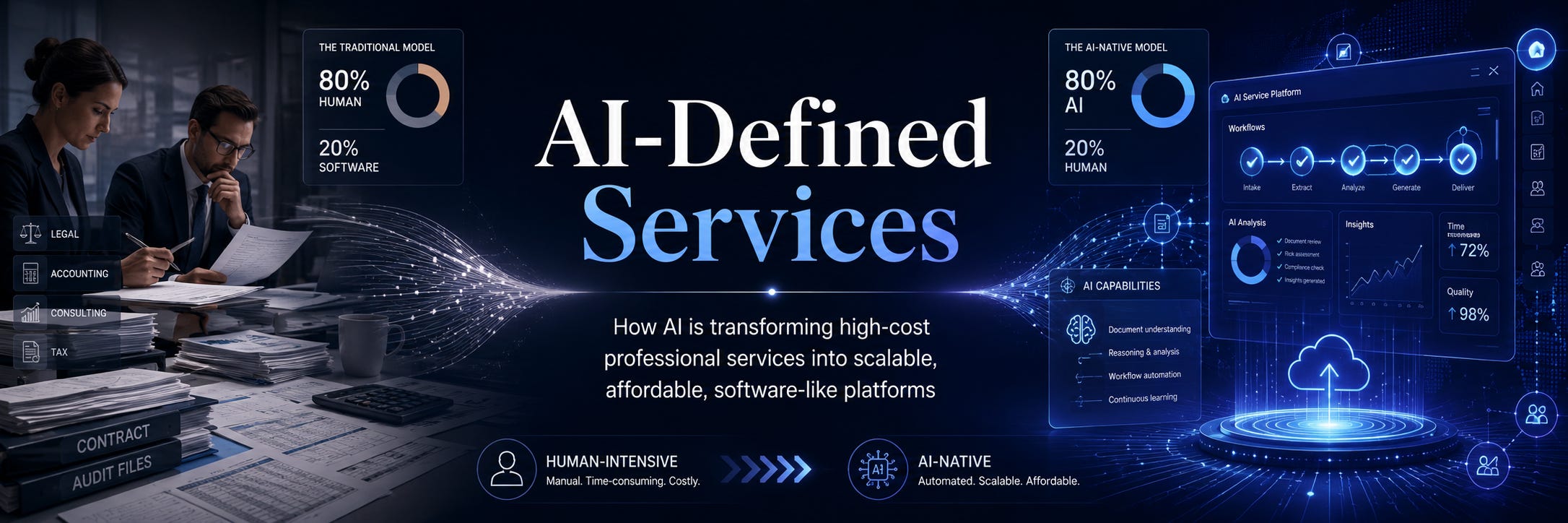
For decades, high-end services like legal counsel and accounting have been dominated by human expertise, requiring costly professional labor. This reliance on highly paid professionals has made these services expensive and often inaccessible for small and medium-sized businesses. But with the rapid advancements in AI, we are entering a new era where service-heavy industries can be transformed into scalable, cost-effective solutions.
Historically, services in industries such as law, finance, and consulting were human-intensive, with roughly 80% of the work performed by highly paid professionals. These industries relied on deep expertise, long hours, and a service-centric approach. However, by leveraging AI technologies, we now have the opportunity to flip this traditional model on its head.
The AI Transformation: 80% Software, 20% Human
In the current system, the ratio is heavily skewed toward human labor, with about 80% of the tasks driven by people and only 20% supported by technology. But as AI evolves, this balance can shift dramatically. Imagine a model where 80% of services are delivered by AI, and only 20% require human intervention. This would radically reduce costs, increase scalability, and improve accessibility to high-end services for a much broader audience.
AI can take over a wide range of functions that were once considered exclusively human. From contract analysis in legal services to complex data processing in accounting, AI-driven systems start to handle these tasks more efficiently and at a fraction of the cost. As the technology matures, its ability to replicate and enhance human expertise will grow, enabling a new wave of AI-native services that cut the need for costly, labor-intensive models.
From Software Eating the World to AI Eating Services
Marc Andreessen famously argued that “software is eating the world.” Software transformed industries by turning products into scalable platforms, delivered through the cloud and improved continuously through SaaS business models.
AI is now bringing a similar shift to services.
The difference is that software scaled products. AI can help scale expertise.
Legal research, accounting audits, financial analysis, consulting workflows, and tax planning have historically depended on expensive human labor. That made these services valuable, but also slow, costly, and inaccessible to many small and medium-sized businesses.
AI changes the model. It can automate much of the manual work behind professional services while keeping humans involved where judgment, trust, and accountability matter most. Expertise still needs a human touch, but with AI, it can be delivered faster, cheaper, and around the clock.
Packaging Expertise Like Software
This creates a new business model: packaging expertise like software.
Instead of building large teams to manually review documents, analyze data, prepare reports, or manage workflows, companies can deliver these capabilities through AI-native platforms. Services that once required weeks of manual effort can become faster, more scalable, and more accessible.
For small businesses, this means access to legal, financial, and strategic support that may have once been out of reach. For enterprises, it means automating complex workflows and reducing the cost of service delivery. The opportunity is not just lower cost. It is a new way to distribute and monetize expertise.
AI-Defined Services
Because professional services require trust, accountability, and expertise, AI-defined service will happen gradually. But given the unlimited intelligence created by AI, the future of services will likely be shaped by AI and human working together. AI will not be another tool, it will reshape how services are built, delivered, priced, and scaled.
Software ate the world by turning products into platforms. AI will eat services by turning expertise into scalable infrastructure.
The winners will be the firms that understand this shift early and use AI not just to improve the old model, but to build a fundamentally better one.