

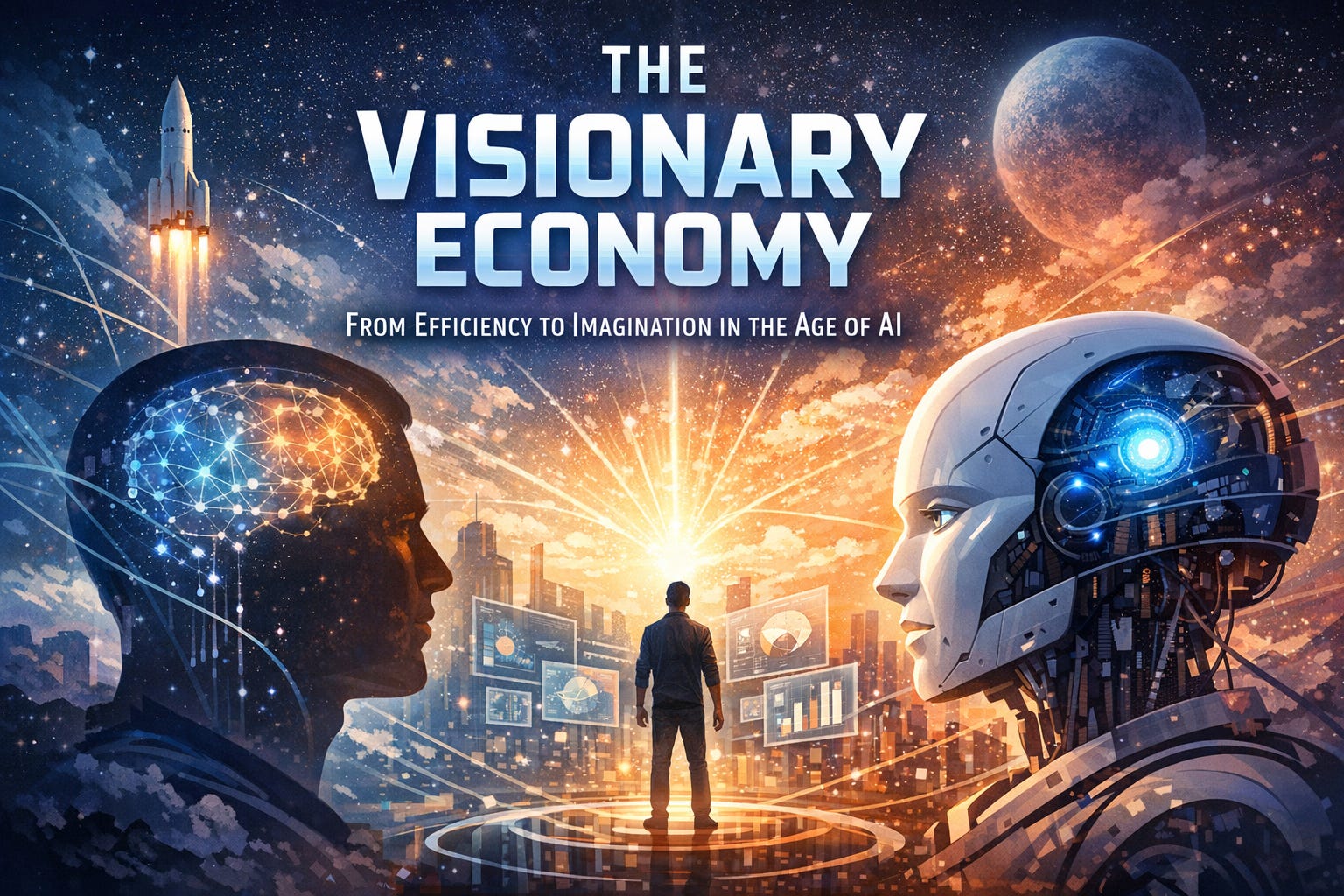
Have you ever wondered what our world would look like if the value of a person were measured not by what they do, but by what they create and the insights they offer? Throughout most of human history, with rare exceptions like Einstein or Da Vinci, people have been rewarded more for their productive capacity than their insights. Whether in agriculture, manufacturing, or even knowledge work like programming, compensation has been tied to output. Those with bold ideas but without the resources to turn them into finished products have often gone unnoticed or unrewarded.
For much of history, the ability to live as a visionary depended on others handling the mechanics of execution. In the past, the ability to live as a “Visionary” required the exploitation of other humans to manage the mechanics of life, whether through the forced labor of antiquity or the rigid hierarchies of the early industrial age. Today, AI provides that same execution layer without the moral cost. It separates imagination from exploitation. AI democratizes the aristocracy.
This imbalance did not arise by accident. This dynamic emerged because our major technological breakthroughs were designed to enhance human productivity. Tools like the plow increased agricultural output. The steam engine and mechanized factories unlocked mass production. Digital systems, from spreadsheets to search engines, helped people work faster and with greater accuracy. Each wave of innovation strengthened a model in which technology serves humans as primarily implementers who executed tasks, operated tools, and followed structured workflows. This is the essence of the “implementer economy”.
An implementer economy is based on the execution of well-defined functions. Its value comes from efficiency, consistency, and reliable output. Workers are rewarded for performing tasks correctly and repeatedly, whether assembling a product, processing information, or transporting a passenger from point A to point B. The underlying logic is simple: when output scales only through human labor, ability to execute becomes the driver of value.
The Industrial Revolution embodied this model. Mechanized production, standardized methods, and factory systems turned labor into predictable units of output. The goal was scale. The worker’s role was to operate machines and ensure smooth, repeatable processes. Creativity mattered only if it could be converted into a product. Everything else was noise.
This system powered immense progress. But it also entrenched a world where creativity, imagination, and unconventional thinking were undervalued compared to efficiency and execution. It created an economy optimized for implementers.
A visionary economy is an economic model that values creativity, insight, and invention over routine execution. Its origins can be traced to the Information Age, when computers and the internet first began to reshape businesses and enable more complex, knowledge-driven work. As the 21st century unfolded, the rapid rise of AI and robotics accelerated this shift by automating repetitive tasks and freeing humans to focus on strategy, exploration, and innovation. In this new paradigm, the most valuable human contribution is no longer execution itself, but the ability to imagine, design, and reimagine systems in motion.
This transition does not eliminate the implementer economy overnight. It exists alongside it. But it no longer defines the frontier of progress. That frontier is now driven by a profound technological shift in artificial intelligence. For the first time in history, machines are capable of performing many tasks with a level of autonomy that mirrors human execution. AI systems can process information, make decisions, and carry out actions that once required human judgment. Robotics is evolving into a parallel implementation layer that can move through the physical world with increasing precision. Together, they form a new execution infrastructure, one that operates alongside humans rather than beneath them.
Autonomous driving offers a vivid example. The work of transporting a passenger from point A to point B, once entirely dependent on human labor, is being taken over by robotaxis that operate continuously and with far fewer constraints. Similar patterns are emerging across logistics, manufacturing, customer service, and knowledge work. As machines increasingly handle the procedural and the predictable, humans are called to operate in the realms of creativity, synthesis, and long-term vision.
This shift empowers a new class of contributors. Visionaries who once struggled to turn ideas into reality now have tools that can bring those ideas to life. With AI as a collaborator, individuals can prototype products, test assumptions, and build solutions that previously required large teams or significant capital. The constraint is no longer execution capacity, but clarity of intent and imagination. The combination of visionary thinking and advanced technology is redefining what is possible and unlocking new forms of economic value.
This is the essence of the visionary economy. It is an environment where creativity is no longer constrained by the limits of human execution. It is a world where imagination scales, experimentation accelerates, and insight compounds. We are witnessing a fusion of human judgment and machine capability that is driving innovation at a pace never before seen.
The visionary economy does more than transform the nature of work. It reshapes how we live, collaborate, and create value as a society. The emphasis shifts from execution to intention, from routine tasks to meaningful creation, and from rigid roles to fluid collaboration between humans and intelligent systems.
Where the implementer economy rewarded efficiency and adherence to predefined tasks, the visionary economy values the ability to generate ideas, interpret complexity, and design solutions that cannot be scripted in advance. Insight replaces instruction. Creativity replaces compliance. Judgment replaces repetition.
Collaboration itself is transformed. Teams are no longer defined solely by human expertise. They now include AI agents that analyze information, generate alternatives, and co-create alongside us. The boundary between individual capability and collective intelligence becomes increasingly thin, enabling individuals to operate at the scale of organizations and organizations to move with the agility of individuals.
The implications are profound. Compensation shifts from task execution toward idea generation and strategic direction. Education evolves from memorization to cultivating creativity, systems thinking, and adaptability. Communities organize around shared missions rather than shared locations. And individuals gain new ways to express their potential, no longer constrained by traditional implementation limits.
The visionary economy represents a foundational transformation in how we define progress. It elevates creativity from a personal trait to an economic force. It empowers individuals to create impact at unprecedented scale. As AI and robotics continue to advance, they will reshape not only our jobs, but our lives, relationships, and collective potential.
The future will not be built by those who execute instructions most efficiently. It will be built by those who can imagine boldly, collaborate intelligently, and guide powerful systems with clarity and purpose.